
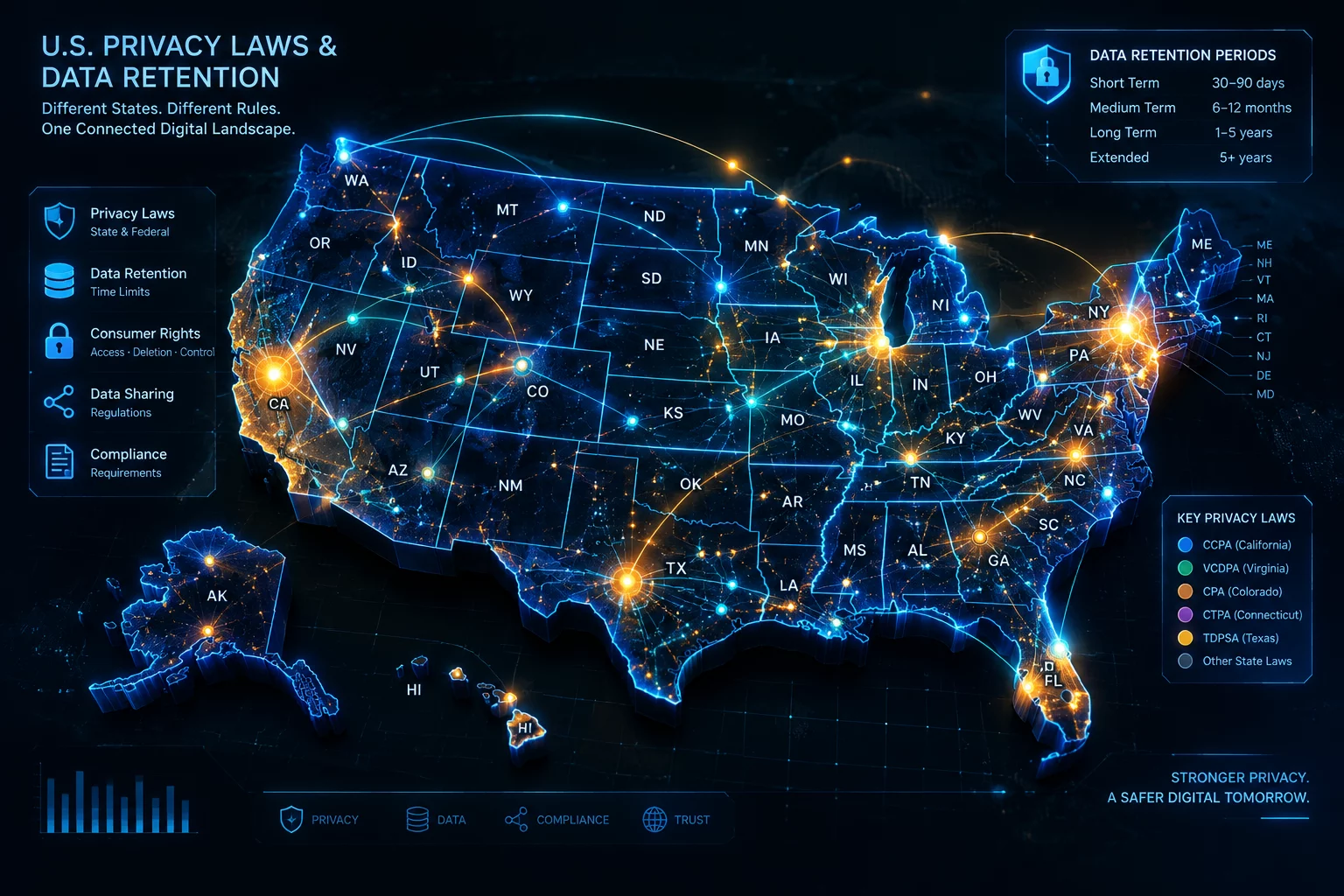
The rapid enactment of comprehensive state privacy statutes across the United States has placed unprecedented scrutiny on corporate data holding habits. Organizations can no longer treat enterprise disk arrays and cloud object stores as perpetual digital attics. State statutes from California and Colorado to Virginia and Texas now mandate strict purpose limitation principles, transforming unmanaged file collections into tangible legal vulnerabilities.
Regulatory Momentum and the Mandate for Storage Justification
Modern state privacy legislation converges on a single fundamental operational rule: personal records and supporting operational files must not be retained longer than reasonably necessary to fulfill the specific purpose for which they were collected. While structured relational databases often benefit from native schema controls, unstructured repositories such as network shares, project archives, and backup dumps frequently escape oversight. IT teams now face the daunting task of retrospectively auditing petabytes of historical files to establish clear statutory justification.
Without documented storage context, departments accumulate orphaned shares whose original authors have departed. Regulatory inquiries and consumer deletion requests quickly expose these blind spots, leading to punitive non-compliance findings and escalating e-discovery costs during litigation. A systematic audit structure bridges the gap between legal policy mandates and technical file storage reality.
Every active directory, network share, and cloud container must be tied to an explicit business owner, an identified operational purpose, and a finite disposition schedule. Indefinite retention without documented justification violates modern state data minimization standards.
Operational Pillars of Defensible Retention Audits
Establishing a defensible storage posture requires moving away from ad-hoc file cleanups toward disciplined, repeatable review workflows. Engineering and compliance teams must collaborate on several core pillars to ensure audit readiness:
- Definite Ownership Tagging: Assigning every folder hierarchy to a designated departmental custodian who validates ongoing business necessity.
- Lifecycle Boundary Enforcement: Mapping directory age distributions against statutory retention schedules to trigger timely archival or secure purging.
- Standardized Documentation Workbooks: Recording baseline scan outputs, review dates, and disposition sign-offs in auditable tabular worksheets.
By leveraging disk analysis metrics and documenting retention rationales systematically, organizations transform unstructured data liabilities into well-governed digital assets. Defensible data retention reviews not only minimize legal exposure under expanding state laws but also dramatically reduce enterprise storage expenses and backup window bloat.
Auditor Log & Discussion
Verified PractitionersSarah Jenkins
Data StewardWe completed the snapshot retention policy audit for primary cloud buckets and legacy shares. The newly enforced 90-day cold compliance benchmark successfully identified 14 orphaned departmental shares that lacked current business justification.
Elena Rostova
Compliance CounselThe revised worksheets provide the necessary legal defense log for our upcoming state privacy attestation. Ensure all department managers complete their quarterly justification sign-offs before the September deadline.
Post Governance Observation
Submit documented storage policy notes, retention exceptions, or verification queries.